

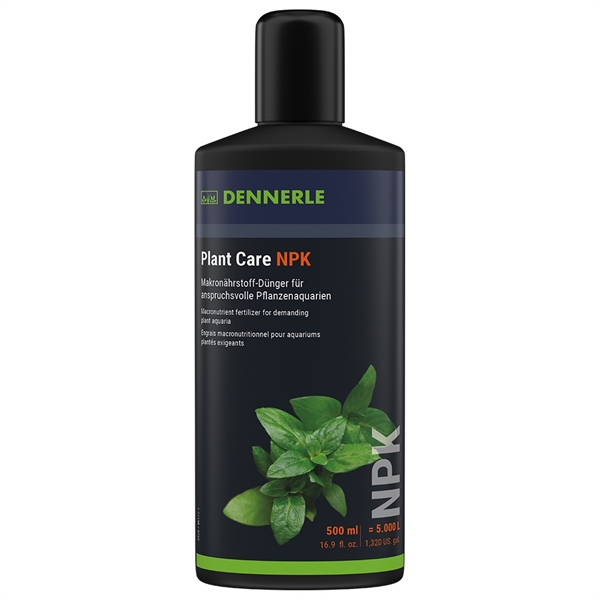

Macronutrient fertilizers for aquariums with few or no fish.
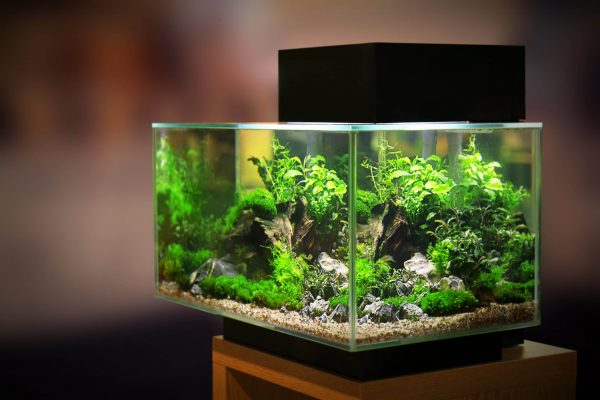
The three macronutrients N = nitrogen (nitrate), P = phosphorus (phosphate), and K = potassium are particularly important. Adding N and P is generally unnecessary in normal planted community aquariums, as these substances enter the aquarium in sufficient, or sometimes even excessive, quantities through fish food and waste. However, the situation is different for demanding planted aquariums or aquascaping aquariums. They have higher than average nutritional requirements, especially regarding macronutrients. In these types of aquariums, a deficiency in N or P can occur quickly, especially with few or no fish. A deficiency in K is also possible, but less common, as potassium is always present in tap water in some quantity and is regularly supplied through complete iron fertilizers such as Plant Care Pro. In the case of demanding planted aquariums, it makes perfect sense to keep a close eye on macronutrients and supplement them as needed. One of the most important aspects of an NPK fertilizer is the biological balance of nutrients. The nutrient ratios in Plant Care NPK have been chosen so that the three macronutrients are absorbed by plants in roughly equal proportions. This means that even with regular, long-term use, there can be no deficiencies or detrimental accumulations of individual nutrients. Nutritional imbalances should always be avoided, as they generally lead to algae problems.
When should I use Plant Care NPK?
Each aquarium has a specific nutrient requirement depending on the number of plants, plant species, animal population, feeding, water changes, and growing conditions (amount/duration of light, CO2 supplementation, filtration technology, etc.). Therefore, the required NPK supplementation must be determined individually for each aquarium. Plant Care NPK is only used when necessary, i.e., when there is a genuine macronutrient deficiency. We recommend measuring the nitrate and/or phosphate levels weekly and dosing Plant Care NPK accordingly. You can also measure the potassium level of the aquarium water (tests are available at specialist stores). However, this measurement is generally unnecessary because tap water, combined with Plant Care Pro and Plant Care NPK, provides sufficient potassium. A potassium overdose is practically impossible and is generally not detrimental. Significant overdoses of nitrate and phosphate, on the other hand, can promote algae growth. Therefore, Plant Care NPK should not be used initially without first measuring the nitrate level and ideally also the phosphate level. If the tap water used for water changes does not contain exceptionally high levels of nitrate or phosphate, later on, measuring the nitrate level alone will suffice as a basis for deciding on fertilization and the NPK dosage. Simple immersion tests can also be used for this purpose, for example, the Dennerle WaterTest 6in1.
Dosage and application
If you have measured and fertilized regularly for several weeks, you can see at what level the measured values stabilize and what macronutrient additions the aquarium needs. Then, you can add the calculated weekly dose of Plant Care NPK as standard and increase the measurement intervals to 2 to 4 weeks with a clear conscience. A good recommendation is 10 ml/100 L/week, which corresponds to an addition of 5 mg/L of nitrate, 0.4 mg/L of phosphate, and 2.5 mg/L of potassium. If the tap water used for water changes contains an exceptionally high level of nitrate (e.g., 50 mg/L) but little phosphate, or high levels of phosphate (>1 mg/L) but little nitrate, then Plant Care NPK should not be used to avoid high levels of individual macronutrients and nutritional imbalances. In this case, Dennerle Plant Care N or Plant Care P fertilizers should be used to specifically address nutrient deficiencies. Because in addition to the absolute concentration of nutrients, nutrient ratios are also important. The nitrate-to-phosphate ratio should ideally be between 10:1 and 15:1. If your tap water contains only small amounts of potassium (e.g., < 3 mg/L), Dennerle Plant Care KPK should be used. This is often the case with very soft water. You can find the analysis values for your own tap water from your local water supplier. They are easily accessible online. Furthermore, potassium is one of the few nutrients that only reaches the aquarium in trace amounts through fish food. A macronutrient fertilizer should always be used in combination with a micronutrient fertilizer. For a complete supply of nutrients and the best possible plant growth, we recommend combining Plant Care NPK with Plant Care Pro.
Macronutrients: Guidelines for Planted Aquariums


Notice
There are no reviews yet.