
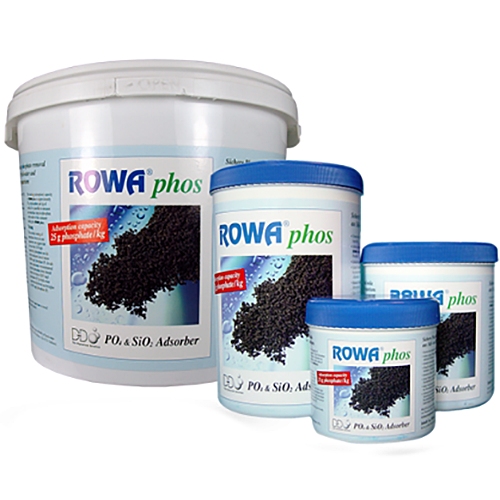

Rowaphos is the professional method for removing phosphates and silicates from all types of aquariums and ponds. Rowaphos is guaranteed to remove more phosphate than any other product worldwide.
In freshwater or saltwater aquariums, phosphates feed harmful algae that can overrun plants and corals, ruining the aquarium's aesthetics and, in extreme cases, killing its inhabitants.
In reef aquariums, phosphates greatly affect coral skeleton formation by reducing calcification by more than 50% and inhibiting strontium deposition. Dr. Borneman suggests that phosphates are a direct poison to calcification.
Rowaphos is a unique, patented material made of chemically engineered iron hydroxide for the effective removal of phosphates, arsenic, and silicates from fresh and salt water. It was initially developed in Germany for treating mains water supplies.
Rowaphos should not be confused with natural materials, which are generally based on aluminum oxide (zeolite) or other iron-based products that claim to be the same product from other manufacturers.
Why Rowaphos?
Only Rowa manufactures Rowaphos, and any other iron-based material is simply a copy with a completely different chemical structure.
Rowaphos has the highest phosphate absorption capacity worldwide and releases nothing back into the water once saturated. The product is easy to use and improves water quality where phosphates or silicates are present in excess.
Consistent use of the product is recommended, as its ability to control harmful algae is a major advantage.
In an independent series of tests conducted by the Technical University of Berlin on the five most commonly used phosphate absorbers at the time, Rowaphos was found to be the most effective at removing phosphates from water. Other media achieved only 30–40% of its removal capacity by weight.
Features :
Will remove 3 ppm of phosphate (PO4):
– 100g: 400 liters of salt water – 800 liters of fresh water.
– 250g: 1000 liters of salt water – 2000 liters of fresh water.
– 500g: 2000 liters of salt water – 4000 liters of fresh water.
– 1000g: 4000 liters of salt water – 8000 liters of fresh water.
Notice
There are no reviews yet.