

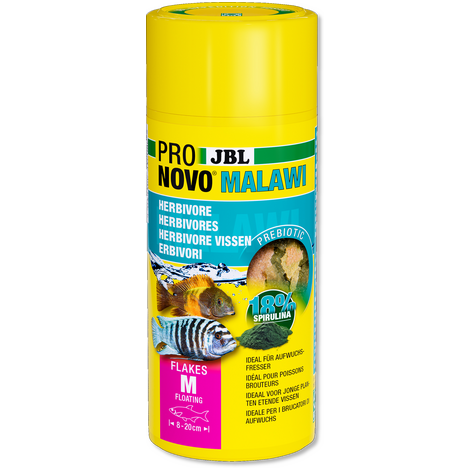
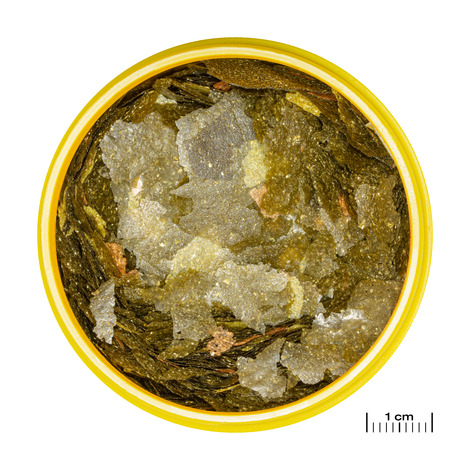

- Aliment prébiotique flottant pour poissons d’aquarium : les fibres alimentaires spéciales contenues dans l’aliment nourrissent les bactéries intestinales positives pour une digestion saine.
- Ingrédients naturels bruts, sans additifs synthétiques, pour une alimentation proche du régime naturel et une bonne santé des poissons d’aquarium. Testés au cours des expéditions de recherche JBL dans les régions tropicales.
- Très grande appétence, même chez les espèces de Cichlidés difficiles, grâce à des ingrédients haut de gamme, telles que saumon, épinard et crevettes.
- Contient de l’astaxanthine naturelle de très grande qualité, extraite de krill et de spiruline, qui garantit une coloration parfaite des Cichlidés, p. ex. ceux des lacs Malawi et Tanganyika.
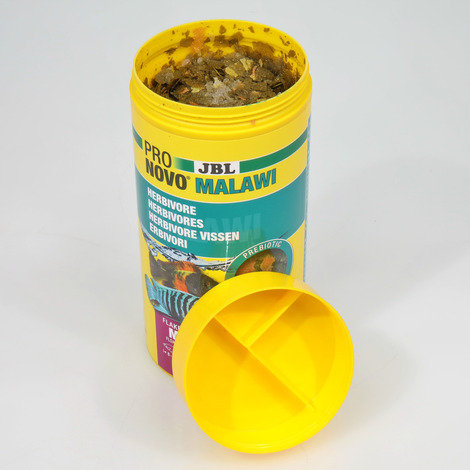
- Contenu : boîte d’origine scellée, recyclable, étanche à l’air et à la lumière, avec doseur à l’intérieur du couvercle.
Dans les grands lacs est-africains (Malawi et Tanganyika), de nombreux Cichlidés se sont spécialisés dans la consommation du tapis algual (daufwuchs) et de ses animalcules. Pour ces espèces, JBL a créé le JBL PRONOVO MALAWI.
Presque toutes les autres espèces des deux lacs sont des prédateurs et mangent poissons, animalcules, crevettes et alevins. Certains mangent même les écailles d’autres poissons (Plecodus). Pour les prédateurs des deux lacs, JBL a créé le JBL PRONOVO TANGANYIKA. Si les deux groupes sont maintenus ensemble dans UN même aquarium, on doit proposer impérativement deux variétés de nourriture. Chaque type de nutrition obtiendra ainsi la nourriture qui lui est adaptée.
Prédateurs typiques du lac Tanganyika : Lamprologus, Neolamprologus, Julidochromis, Cyphotilapia, Telmatochromis, Calinochromis. Prédateurs typiques du lac Malawi : Trematocranus, Haplochromis, Nimbochromis, Sciaenochromis, Labidochromis.
Les avantages de la nourriture JBL :
– utilisation de pures protéines de poisson, sans farine de poisson bon marché,
– proportion protéines/lipides idéale,
– essentiellement des protéines d’animaux aquatiques,
– réduction de la croissance des algues et croissance optimale des poissons grâce à une teneur en phosphates adaptée.
Prébiotique : les prébiotiques sont « des
« des substrats utilisés de façon sélective par des micro-organismes de l’hôte et qui produisent un bénéfice pour la santé ». Ici, les scientifiques s’accordent à dire qu’ils favorisent la digestion et donc la santé. Chez nos poissons, un autre aspect important vient s’y ajouter : grâce à une meilleure digestion, les déjections sont moins importantes et donc l’eau est moins polluée, ce qui réduit l’apparition de problèmes d’algues. L’eau reste plus propre.
La majorité des Cichlidés du lac Tanganyika étant des prédateurs, l’aliment pour ces espèces a été appelée PRONOVO TANGANYIKA. Les espèces du lac Malawi étant majoritairement des brouteurs d’algues, cet aliment s’appelle PRONOVO MALAWI.



Avis
Il n’y a pas encore d’avis.